Alec Gilmore
Educator and Lecturer

Lent Revisited
An invitation from the Lewes Deanery in 2005 to deliver three lectures in their annual Holy Week services led me to look again at the biblical texts in the light of the medieval Feast of Fools and recent thinking on the place of laughter and fun, fantasy and festivity in Christian Festivals.
The result was a mix of biblical scholarship, traditional hymns and contemporary readings, bringing a fresh approach to a familiar Festival, raising questions leading to prayer, worship and commitment.
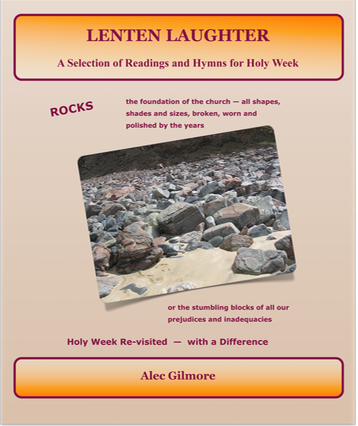
There is also a Bible Study version (after the pattern of Guidelines) based on the lectures, intended for use in Holy Week or any time during Lent and exploring the biblical texts relating to Easter. Is Austerity the only way to handle Lent? Might there be something here that we have missed, and is there some evidence for it in the texts themselves if we ponder their depth? These can be found in the Bible Studies section.
Good Friday - A Laughing Stock
An invitation from the Lewes Deanery in 2005 to deliver three lectures in their annual Holy Week services led me to look again at the biblical texts in the light of the medieval Feast of Fools and recent thinking on the place of laughter and fun, fantasy and festivity in Christian Festivals. The result was a mix of biblical scholarship, tradi-tional hymns and contemp-orary readings, bringing a fresh approach to a familiar Festival, raising questions leading to prayer, worship and commitment.
Easter Sunday - The Last Laugh
An invitation from the Lewes Deanery in 2005 to deliver three lectures in their annual Holy Week services led me to look again at the biblical texts in the light of the medieval Feast of Fools and recent thinking on the place of laughter and fun, fantasy and festivity in Christian Festivals. The result was a mix of biblical scholarship, tradi-tional hymns and contemp-orary readings, bringing a fresh approach to a familiar Festival, raising questions leading to prayer, worship and commitment.
Palm Sunday - A day for laughter
Easter Sunday - The Last Laugh
Traditionally, if the season of Lent has been a time of stringency and hardship, punctuated maybe by smiles but not guffaws, and Good Friday a day of anguish and sorrow, then **Easter Day** has been the day to laugh your head off. The devil had been defeated. Evil had been routed. The dead had come to life and hope had replaced despair. It was the happy ending.
Palm Sunday - A day for laughter
The difficulty with Lent and the whole Easter saga for regular churchgoers is that we have gone through it all too often. We know the stories backwards and the exercises that go with them. We absorbed them with our mother’s milk, heard them at our grandmother’s knee and framed them in Sunday School or Family Church.
Good Friday - A Laughing Stock
If Palm Sunday approximated in any way to the medieval Feast of Fools then **Good Friday** put the Fools in their place. Good laughter turned sour. A good joke back-fired. The crowd changed their mind. Authority got the upper hand and re-gained control.
{{item.title}}
{{item.description}}