Alec Gilmore
Educator and Lecturer

Essays on Steinbeck
An extended visit to California gave me the opportunity to explore Steinbeck territory beginning with the Steinbeck Center in Salinas and continuing with more persistent research at Stamford and San José Universities, resulting in a series of essays on a variety of themes focusing on Steinbeck’s biblical images, his approach to religion in general and his excursions into the meaning and purpose of life.
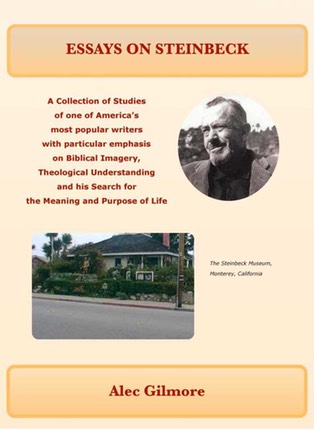
Religion in Grapes of Wrath The Bible (especially Judaism) in East of Eden The Holy Grail in Mallory’s 'Knights'Days in Bruton and His Farewell Essay in The Winter of our DiscontentTen Essays on Steinbeck Themes
First Impressions
I came to Steinbeck rather late in life as a result of reading The Grapes of Wrath followed by an extended visit to a relative in California which gave me the opportunity to explore Steinbeck territory — not only Salinas and Monterey, where he spent his early years and which provided the backgound to so much of his writing, but also Corral de Tierra, background to East of Eden, and Jolon, thought to be the inspiration for To A God Unknown.
{{item.description}}
A paper examining 'Steinbeck’s Multi-layered Use of the Biblical Image' in Michael J Meyer, The Grapes of Wrath. A Re-consideration pp 129-148, published by Editions Rodopi, Amsterdam/New York, NY 2009, xix, 908 pp. (2 Volumes) (Dialogue 7), with documentation and bibliography.
This study (in the Dialogue series) presents analyses by senior Steinbeck scholars and several new voices. Issues addressed include accusations about the novel's sentimentality, speculations about its status as a work of naturalism, and questions about its experimental structure. In addition, the language and imagery of the novel, its religious overtones, and its reputation as a radical work of art are revisited with fresh insights.
A study of Steinbeck’s quest for Malory’s Holy Grail in the light of his own experience. Is the quest for biblical symbolism and allusion in Steinbeck exhausted? Or is it just beginning? Suggestions for a different way of handling it which could open up Steinbeck to a whole new range of readers.
An examination of the writings of Steinbeck to explore his approach to religion through three windows, which cannot be isolated from each other and most of which turn up in nearly everything he wrote, though the emphases vary. First, biblical references, sometimes in titles, sometimes in people and sometimes in content,The Grapes of Wrath and East of Eden being the two most obvious examples. Second, biblical themes and imagery, such as the wilderness, sibling rivalry, water, and theological experiences (if not language) relating to guilt, sin and forgiveness. Third, the characters he creates and the characters whose company he obviously enjoys which tell us something about the values he embraces and are a reflection of the ‘God’ who motivates him. Published [as John Steinbeck], in The Expository Times, vol 112 no 6, March 2001, pp 192-196, with documentation.
{{item.description}}
Religion
Steinbeck’s mother told him Bible stories from an early age which stood him in good stead when it came to writing many of this novels and stories. As he matured he showed evidence not only of knowing the stories but also of understanding them, often with quite sharp and penetrating incite, aided and abetted by his increasing awarenesss of Judaism and a friendly rabbi.
A paper relating John Steinbeck's understanding of Community to Wheeler Robinson's theory of Corporate Personality, clarifying the similarities and differences.
Published in Steinbeck Studies, vol 15, no 1, Spring 2004, pp 73-87, with documentation and bibliography.
John Steinbeck (1902-68) is best known for The Grapes of Wrath, never out-of-print, still selling at the rate of 50,000 copies every year in the USA alone, and regarded in many USA schools as history, though he wrote 26 other novels and plays, several collections of short stories and numerous newspaper articles, and gained the Nobel Prize for literature.
Isaiah (6th century BCE) is best known for quotes such as ‘He was despised and rejected, a man of sorrows and acquainted with grief’ and ‘Surely he hath borne our griefs and carried our sorrows’, thanks largely to Handel’s Messiah which is regularly sung in churches and Concert Halls at Christmas and Easter and is regarded by many as a significant part of British culture. The chapter from which those quotes are taken however from one of four poems, familiar to mid-20th century biblical scholars as the Suffering Servant Poems (or Songs), and it is here we must begin, since the purpose of this paper is to examine possible connections between Isaiah’s Suffering Servant and Steinbeck’s close friend and mentor, Ed Ricketts.
A paper exploring the meaning of timshol in East of Eden in the light of Steinbeck's magnum opus. Published in Michael J Meyer and Henry Veggian (eds), East of Eden. New and Recent Essays, Editions Rodopi, Amsterdam/New York, NY 2013, pp 257-288.
This study (in the Dialogue series), designed to commemorate the 60th anniversary of the novel's publication, contains critical writings from a number of literary fields, including a biographical essay, a travel essay, further essays on varied themes in Steinbeck's works, writing on critical approaches to Steinbeck and a new essay on Elia Kazan's film adaptation of the novel.
{{item.description}}
During the Second World War Steinbeck spent six months in England as a War Correspondent for the Herald Tribune. His letters and dispatches tell us much about his war experience, but what was life like in England in 1943, the fourth year of World War 2?
Steinbeck and his wife, Elaine, spent the summer of 1959 in England, in a tiny cottage in Bruton, Somerset, part rest cure from the pressure of American critics and part in quest of Mallory and the Holy Grail. What were their impressions of church and community, day-to-day life in Bruton, and West Country transport, and what did he absorb of Mallory and the Holy Grail in Glastonbury? I went to Bruton to find out, and on to Glastonbury and Tintagel, to retrace some of his leisure moments.
This piece meditates on Steinbeck's interpretation of the American Dream, his quest for ideals in his translation of Malory, and his application of this Dream and this quest in The Winter of Our Discontent. But did Steinbeck's writing go off after failing to find the Holy Grail, or is The Winter of Our Discontent a sign that he had in fact found it, albeit not quite what he had been looking for nor what his critics were hoping he might find?
So was his quest Success or Failure — an End or a New Beginning? Did the quality of Steinbeck’s writing go off following his failure to find the Holy Grail (as some of his critics have suggested) or is The Winter of Our Discontent an indication that he had in fact found it, albeit not quite what he had been looking for nor what his critics were hoping he might find?
First published in Steinbeck Review, vol 12, no 1, 2015, pp 74-86, with documentation and bibliography
{{item.description}}